What Should You Do When Your Driveway Has Become Cracked, Uneven and Difficult to Use?
A driveway is expected to provide a stable, practical surface for everyday access, but its condition can gradually deteriorate over time. Small cracks may become wider, isolated depressions can develop into noticeably uneven sections, and areas that once drained effectively may begin holding water. Eventually, a driveway can reach the point where its condition affects both its appearance and how comfortably it can be used.
When several problems are appearing at the same time, repeatedly treating individual defects may not address what is happening beneath the surface. For homeowners in Ipswich, Suffolk, a professional driveway assessment can determine whether localised repairs remain appropriate or whether more comprehensive resurfacing or replacement would provide a better long-term solution. Ipswich Driveway Solutions can assess the complete driveway and recommend an approach based on its actual condition.
Start by Looking at the Driveway as a Whole
When deterioration first appears, attention naturally focuses on the most obvious crack, dip or damaged section. However, once several defects are present, it is important to consider the driveway as a complete structure.
Look for problems such as:
- Cracks appearing in multiple areas
- Sections beginning to sink
- Uneven levels
- Loose or deteriorating surfacing
- Water collecting after rainfall
- Worn vehicle tracks
- Weak or damaged edges
- Previous repairs beginning to fail
Several symptoms occurring together can suggest that the issue extends beyond normal surface wear.
Why Do Driveways Become Cracked?
Cracking can develop for several reasons, and understanding the cause is important before deciding how the driveway should be repaired.
A driveway surface depends heavily on the layers underneath it. If the foundation moves, settles or loses stability, the surface above may eventually reflect that movement.
Cracks may also develop as materials age and experience repeated loading and weather exposure.
Repairing a visible crack without considering why it appeared can mean the same problem eventually returns.
Uneven Areas Can Point to Problems Below the Surface
A driveway that has developed dips, depressions or raised sections deserves closer inspection.
Surface deformation can sometimes indicate that the supporting layers beneath the driveway are no longer performing consistently. This might result from inadequate original preparation, localised settlement or deterioration that has developed gradually.
The important point is that simply covering an uneven area does not necessarily correct the underlying cause.
Professional assessment allows the complete construction to be considered before deciding on the appropriate solution.
Standing Water Should Not Be Ignored
If puddles remain on the driveway after rainfall, the surface levels may no longer be directing water effectively.
Water can begin collecting where sections have settled or where the original falls were insufficient. Over time, persistent water around already weakened areas can contribute to further deterioration.
A properly designed driveway should consider drainage from the beginning, including:
- Finished surface levels
- Appropriate falls
- Surrounding ground
- Entrances and boundaries
- Low points
- Existing drainage arrangements
When improving an old driveway, correcting problematic levels can be just as important as replacing the visible surface.
Difficult Access Is a Sign the Driveway Is No Longer Performing Properly
A deteriorating driveway is not simply an appearance issue.
Uneven surfaces can make walking less comfortable and can create noticeable bumps when vehicles enter, leave or manoeuvre on the driveway.
Loose material, broken edges and depressions can also make routine use increasingly frustrating.
If you find yourself regularly avoiding certain parts of the driveway, this is a strong indication that its condition should be assessed.
Can Individual Areas Still Be Repaired?
Localised repair can be appropriate where damage is genuinely confined to a small section and the surrounding driveway remains stable.
For example, one isolated defect does not necessarily justify replacing an otherwise serviceable surface.
The decision becomes more complicated when:
- Cracking is widespread
- Several areas have sunk
- Previous repairs are failing
- The surface is deteriorating throughout
- Drainage problems affect multiple sections
- The driveway has become generally uneven
At this stage, continuing to repair individual symptoms may not provide the improvement the driveway actually needs.
When Is Resurfacing Worth Considering?
Where the underlying structure remains suitable but the upper surface has become worn, resurfacing may sometimes be an appropriate option.
The key requirement is that the existing base must be capable of supporting the renewed surface.
Applying new material over an unstable foundation does not remove the instability underneath. Existing movement can eventually affect the new surface as well.
This is why the condition beneath the visible driveway needs to be understood before resurfacing is recommended.
When Might a New Driveway Be the Better Approach?
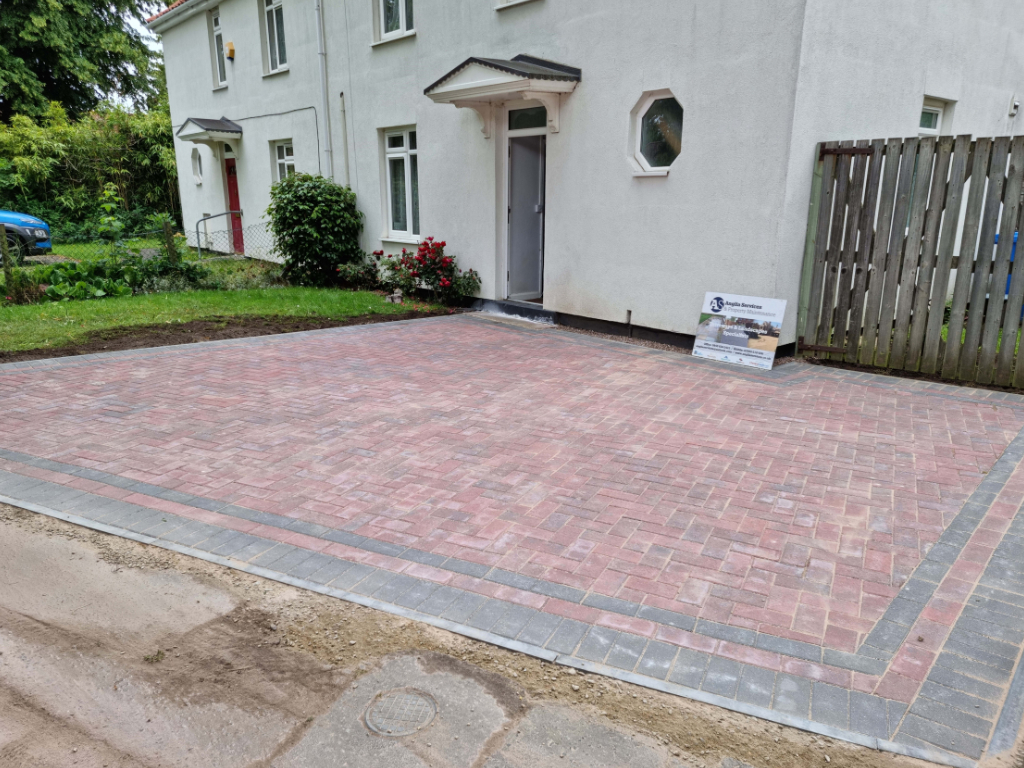
Where deterioration is widespread or the existing construction has significant underlying problems, replacing the driveway can provide an opportunity to address the entire area properly.
Rather than continually working around old defects, a new installation allows important elements to be reconsidered, including:
Ground preparation
The existing surface can be removed so that the condition underneath can be properly addressed.
Sub-base construction
A suitable foundation can be created to support regular use.
Levels
The driveway can be designed with appropriate falls and transitions.
Drainage
Water management can be considered as part of the complete installation.
Layout
The usable area can potentially be improved to suit how the property is currently used.
Surface choice
A suitable driveway finish can be selected according to the property and intended appearance.
This comprehensive approach can be particularly worthwhile when an existing driveway has several different problems occurring simultaneously.
Why the Sub-Base Matters So Much
The visible surface receives most of the attention, but the sub-base plays a major role in determining how well a driveway performs.
A properly prepared foundation helps distribute loads and provides a stable platform for the finished surface.
If the supporting construction is inadequate, problems can eventually appear above it, including:
- Settlement
- Movement
- Depressions
- Cracking
- Uneven sections
High-quality driveway installation therefore begins below ground level.
At Ipswich Driveway Solutions, careful preparation forms an essential part of creating a driveway designed for dependable everyday use.
Choosing the Right Surface for the Replacement
If a driveway has reached the stage where replacement is appropriate, homeowners have an opportunity to reconsider the finished surface.
The best option depends on the property, desired appearance and practical requirements.
Different driveway materials can offer different characteristics in terms of:
- Appearance
- Texture
- Design flexibility
- Maintenance requirements
- Suitability for the available space
- How they complement the property
A professional driveway contractor can explain the available options and help determine which surface is most suitable for the individual site.
Good Edging Helps Maintain the Finished Driveway
Driveway edges are an important part of the complete construction.
Where edges become weak or unsupported, deterioration can begin around the perimeter and gradually affect adjoining sections.
Suitable edge restraints can help maintain definition and support the finished surface while creating a cleaner transition between the driveway and surrounding garden areas.
Edging should therefore be considered as part of the overall installation rather than simply as a decorative finishing detail.
A New Layout Can Improve Everyday Use
Replacing a badly deteriorated driveway can also provide an opportunity to reconsider whether its existing layout still works effectively.
How a household uses its driveway can change over time.
When planning improvements, it can be useful to consider:
- Vehicle access
- Parking positions
- Pedestrian routes
- Entrances
- Turning or manoeuvring space
- Connections with paths
- Surrounding landscaping
A well-planned driveway should work practically for the property rather than simply occupy the same footprint as the previous surface without question.
Why Professional Assessment Comes Before the Solution
It can be difficult to determine from appearance alone whether a driveway needs repair, resurfacing or replacement.
Two driveways may display similar cracks but have completely different underlying conditions.
A professional assessment can consider:
- The extent of cracking
- Surface movement
- Existing levels
- Drainage performance
- Condition of the edges
- Signs of settlement
- Previous repairs
- The general stability of the driveway
This makes it possible to recommend work based on the cause and extent of deterioration rather than simply covering the most visible damage.
Avoid Repeatedly Treating the Symptoms
One of the most important considerations with a badly deteriorating driveway is whether previous repairs are achieving anything beyond a temporary visual improvement.
If new cracks repeatedly develop or repaired sections continue moving, there may be a more fundamental problem with the existing construction.
At that point, continually treating individual defects can become increasingly ineffective.
Addressing the underlying cause gives the driveway a much better foundation for future performance.
Professional Driveway Solutions in Ipswich
At Ipswich Driveway Solutions, we provide professional driveway services throughout Ipswich, Suffolk, with solutions tailored to the existing condition of each property.
If your driveway has become cracked, uneven, worn or increasingly difficult to use, we can assess the complete area and determine what type of improvement is appropriate.
Our focus is on the factors that influence long-term driveway performance, including preparation, stability, levels, drainage and quality installation. The objective is not simply to disguise existing problems but to create a practical and attractive surface suited to everyday use.
Conclusion
When a driveway has become cracked, uneven and difficult to use, the first step should be understanding why the deterioration has occurred. A small isolated defect may only require localised attention, while widespread cracking, settlement, drainage problems and repeated failures can indicate that more comprehensive work is appropriate.
The condition beneath the surface is particularly important. Without a stable foundation and correctly planned levels, simply renewing the visible surface may not resolve the underlying problems.
For homeowners in Ipswich, Suffolk, Ipswich Driveway Solutions can assess deteriorating driveways and recommend an appropriate approach based on their current condition. If your driveway is becoming increasingly difficult to use or no longer provides the appearance and performance you expect, contact our team to discuss how it could be professionally improved.
Call us on: 01473 943 391
Click here to find out more about Ipswich Driveway Solutions
Click here to complete our contact form and see how we can help with your driveway needs.